

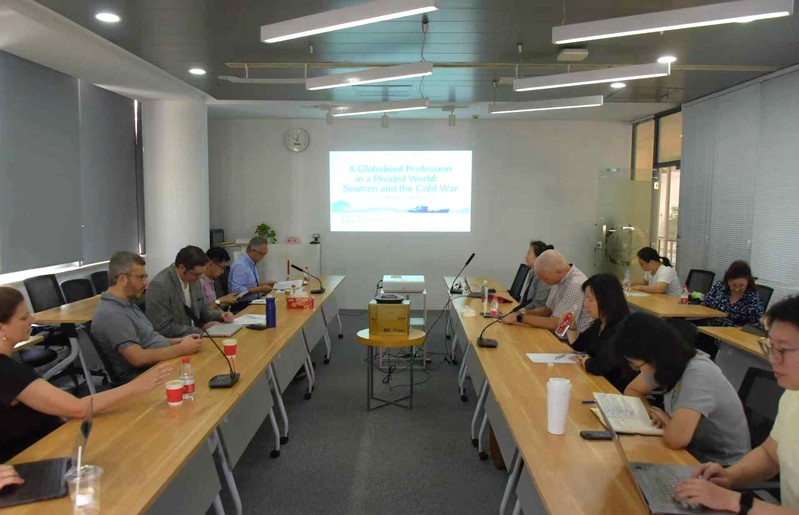
Speaking about the Cold War, we often think about the standoff that occurred along the borders between the capitalist and the socialist blocs. But in the lecture ‘A Globalised Profession in a Divided World: Seamen and the Cold War’ held on September 15th, Professor Qingfei Yin from the London School of Economics presented to us another side of the period—the Cold War on the high seas. After several centuries of development, the maritime industry in the twentieth century was arguably already a globalised business. Its traces could be seen across the world, and merchant marines were going back and forth between countries. Studying the shipping industry through the prisms of maritime and global Cold War histories, Professor Yin sought to answer the question: how did the onset of the Cold War impact maritime trade?
The lecture centred on two case studies based on rigorous archival research. The first case is about the experiences of foreign seamen who stayed in China during the 1950s and 1960s. The establishment of the People’s Republic of China did not close the country to the outside world. Quite on the contrary, an unignorable number of foreign commercial vessels docked in Chinese ports on their voyages. The Communist government thus had to decide upon how to host these foreign seamen. As a socialist state, the PRC sought to uphold proletarian internationalism; it treated foreign seamen as a part of the international working class and tried to host them in a suitable manner. To this end, the policy of ‘treat (seamen) equally but differently’ was developed to give positive discrimination to seamen from other socialist countries and workers of colour, who were heavily discriminated against, working on vessels from capitalist countries. Based on her archival research, Professor Yin argued that some lascar seamen were indeed emotionally moved by the Chinese authority’s hospitality. In addition, the Chinese government also set up seamen’s stores in its ports, which sold daily goods at a very cheap price to sailors. Although the stores could help seamen alleviate their cost of living, the professor also suggested that it was a way for the government to build up China’s foreign reserve so that it could develop China economically.
Another case that Professor Yin presented is the experiences of Chinese seamen working in the British merchant marines. The British government have long viewed Chinese seamen as a source of unrest because of their history of militancy, most famously in the case of the 1922 Hong Kong seamen strike and the 1925 Hong Kong-Canton Strike. After the beginning of the Cold War, British concern about them was exacerbated. To prevent the Chinese seamen from turning militant, the British government attempted to have spies infiltrate Chinese seamen associations and coordinate their information gathering activities with shipping enterprises, it even thought about how to completely replace all Chinese employees in the merchant marines with workers from other ethnicities. But in the end, these attempts all ended in failure.
The talk was followed by a lively discussion between Professor Yin and three historians from related fields. The first to participate in the discussion was Professor Zhang Yang from Fudan University. A fellow scholar of Cold War history, Professor Zhang spoke highly of the lecture’s focus on marginalised communities during the Cold War and wished to know more about the experiences of Chinese seamen working in China and what the foreign seamen’s impression of China was. The next discussant was Professor Brett Goodin from ShanghaiTech University. Professor Goodin has worked extensively on American maritime history and was very interested in how historians studying the PRC analysed sources. Comparing this with his experiences handling sources, he was very impressed with Professor Yin’s research and offered helpful advice. The last discussant was Professor Mark Hoskin at the Museum of the First Sino-Japanese War. Having been a seaman in his past, Professor Hoskin offered interesting insights into the life of a seaman based on his own experiences. He also reminded the audience that the problems Chinese seamen encountered are not just history, but also issues affecting the lives of marginalised seamen right now.
In all, the lecture offered the audience an opportunity to learn about the Cold War from a new perspective. The Cold War is undeniably a clash of ideologies, but the impact it brought is also complex and nuanced, so much so that seamen working in the same industry and at the same time developed very different experiences. We hope that Professor Yin’s research can allow more people to better understand the history of the Cold War.